Committing to weight loss isn’t a decision you make once.
It’s a series of decisions you make every day, throughout the day, multiple times a day.
The days turn into weeks.
Then months.
Then, somehow, a year.
A year’s worth of thousands upon thousands of decisions range from seemingly inconsequential to monumental to overwhelming — as do the results.
The person I was a year ago today was shattered, tentative, reeling, and supremely unhealthy in every way. She got moving because her mind became so paralyzed by external inputs that it shut down and her body took control. She was in no way the “she believed she could, so she did!” meme; she was trapped kinetic energy, desperate to escape the confines of her physical being. A year ago today, she wasn’t trying to do anything beyond survive the next 10 minutes.
She would be floored to hear what she was about to do over the next 365 days.
She got reacquainted — painfully, slowly, and sweatily — with the elliptical, in 5-minute increments, until she could do a continuous hour. It took her 4 months to go from 6 miserable minutes to 60 manageable ones.
Then she ran 4 elliptical miles in 60 minutes.
Then 5.
Then 6.
Then 7.
Then she ran 8 elliptical miles in 70 minutes.
Then 9.
Then 9.3.
She ran 30 seconds on her bum ankle on the treadmill, at a pace barely above walking.
Then 60-second intervals.
Then 90-second intervals.
Then 2-minute, 3-minute, and 5-minute intervals.
She increased her speed and ran a full mile.
Then 2.
She dutifully iced and elevated her ankle after every run until it learned it could handle it.
So she increased her pace and kept at it.
She signed up for, self-trained for, and finished a half-marathon.
She saw her finish-line photo and, for the first time, saw a runner.
She then registered for 2 more half-marathons.
She became an athlete.
She tried 75 Hard. She got sick, got rained on, got injured, and bled through her clothes while refusing to abandon her workout. She completed the challenge.
She rediscovered her love of being outside and how restorative it is to her mind and body.
She got trapped by 14 inches of snow before vacation. She spent 4 days digging out, arrived at her destination only to have to dig that out, too. She went running on the frozen beach the next day.
She made up and tried Power 11. No one was watching. She finished it as competitor, coach, and cheerleader.
She dealt with illness, pain, interruption, inconvenience, and deterrence. She found ways to move anyway. It made her stronger.
She became someone who does not quit.
She cut added sugar completely out of her diet for several months, both in a row and in a cumulative-intermittent fashion.
She experimented and figured out what type of eating schedule her body responds best to.
She gained new nutritional knowledge.
She learned her hunger and satiety cues and no longer has cravings or urges to snack.
She found herself deaf to food noise and disinterested in consuming anything that wouldn’t support her health.
She tested new recipes and gave second, third, and fourth chances to foods she’d previously decided she didn’t like — and discovered she liked them when prepared differently.
She turned herself into an exceptional menu planner and meal prepper, and a creative experimental chef as well as a more-adventurous eater.
She learned she could be healthy by liking everything she eats, even if she doesn’t necessarily eat everything she likes.
She became someone who nourishes herself.
She eats to feed herself, not her cravings.
She keeps promises to herself first, not last.
She exercises for self-love, not self-punishment.
She became someone who takes care of herself.
If I could somehow sit beside Past-Me and tell her what her first decision one year ago would lead to today, she would hardly believe it. Looking at it now — knowing it happened — I admit there’s a small part of Present-Me that hardly believes it, too. Would vocalizing a year’s worth of select spoilers to her make it feel more real to both of us?
Hey girl. Life is about to change profoundly for you.
You’ll go through stretches of cooperation with an alacritous scale, reliably dropping pounds in a way that motivates you to keep going — yet no one notices you’re getting smaller. But you don’t care, because this feels fragile, and having other people’s voices enter the conversation you’re having with yourself feels like a possible destabilizer. You’re not trying to have that right now. This is yours. You protect it and you keep moving forward.
After about six months, you enter what feels like interminable stagnation with what the scale shows you. You seriously consider burning your scale and buying a new one that isn’t such a damn liar. Then one day, you stop to eat on your five-hour drive to your brother’s baby shower for the weekend. When you get out of the car and close the door behind you, your ring goes flying off your finger and skitters across the parking lot. You chase after it in maniacal laughter. You suddenly don’t care about the scale anymore.
You’ll become obsessed with the process. You’ll get sick of it. You’ll be nonplussed by it. You’ll be unfazed by it. And, eventually, you’ll be integrated with it.
It will challenge you. It will teach you. It will strengthen you. It will humble you. It will empower you.
It will you-ify you.
You will start to love the person you’re excavating. You’ll understand her in ways that were too inaccessible, too intense, too scary before. But they’re possible a year from now, because you trust yourself after the months of investing in yourself.
And when it feels too hard, you’ll invoke one of your two mantras:
1) “This is easy.” Not because it is, but because after everything you’ve done — like coaching yourself through those first breathless minutes on the elliptical at nearly 300 lbs — running that measly treadmill mile is nothing. Every time you push yourself, you put your arms around the version of you who truly wanted to go, but genuinely couldn’t. The person you’re becoming is doing it for the person you used to be. She lit the match. You carry the torch.
2) “I am so strong.” Because you are. And you know it.
You’ll become your own inspiration. You’ll become your own cause to honor. And you’ll become your own best friend.
As your process continues, you’ll clock the outwardly visible changes:
- Your face is narrower. You can see the piercings in your ears without turning your head — including the 4 new ones you’ll get in the first half of 2026 that punctuate your progress.
- Your collarbones, shoulders, and neck muscles are poppin’. You think it makes you look more feminine.
- Bye bye, boobies / ta ta, titties — the girls have done some shrinking.
- Your arms are thinning out. The gardening gloves that are supposed to be roomy, finally are. The wristband for your VivoFit has more excess band beyond the closure notch than it does before it. Sleeves don’t cut off circulation anymore.
- Shirts don’t squeeze your torso anymore.
- You’ll spend a small fortune trying to keep up with replacing the underwear that hangs and slides off your ass in a constant struggle with gravity.
- Your legs don’t brush together with every step anymore. Your knees are bonier. Your quads and hamstrings show definition as if you’re some kind of… runner.
- Your over-developed calves still touch when you stand, but now so do your ankles when you lie down.
- There’s all kinds of space between your toes now.
- You go down a half shoe size.
- You go down 5 dress sizes.
- You go down 6 pants sizes.
- You go down 4 shirt sizes.
- You lose a cup size.
- You can wear a necklace that, when it was first gifted to you, inspired the indignant thought, “whose neck is that small?!”
- You can wear a ring on your middle finger that, when it was first gifted to you, fit none of your fingers.
- You can wear what you want instead of settling for what fits.
- You look happy, not haunted.
You’ll note the things your body can do now that it couldn’t a year ago:
- There’s not a seat you can’t sit in. Airplane. Theater. Stadium. Desk chair. Restaurant booth. Behind the wheel, you have to move the seat forward one day simply because the excess fat is no longer pushing your whole body forward and closer to the pedals, and you can’t reach the steering column without adjusting the position. When you put on your seatbelt, you pull it across your body and buckle it in one fluid motion instead of pulling it out as far as it can go in order to fasten it.
- Regular belts? Also a thing you can fasten.
- You can carry purses and bags with long straps without having to hold onto them the whole time so your hip isn’t bumping them off because it sticks out too far when you walk.
- You aren’t constantly making contact with the shower curtain or running out of breath when you shower.
- Those two creaky bottom steps that embarrass you at your parents’ house? They stop making noise when you walk on them. Actually, you don’t really walk on them; you run up and down stairs now. On your tiptoes. The way you did when you were a kid.
- Your ankle is chatty and whiny sometimes, but it doesn’t refuse to play. In fact, it takes very little — if any — ice or elevation to recover from what you ask of it. Inflammation in general is barely even a thing for you these days.
- You almost never get headaches anymore.
- You do half marathons.
- You do Pilates. It’s hard. It kinda sucks sometimes. You love it. Oh yeah — you have core strength now.
- You do 6+ miles on the elliptical in an hour and it’s a casual cardio night.
- Perhaps to your greatest surprise, your menstrual cycle comes back. It will come regularly, like clockwork, every month for you, starting in October. At the start of each one of the first five periods you get in a row, you will cry on the toilet. And then you will laugh at yourself for crying on the toilet.
You’ll log the stats:
- You don’t randomly wake up with your heart racing anymore. Your average blood pressure is 101/68 and your average resting heart rate is 57 bpm.
- 21 DietBets won (and you’re working on 3 more).
- 252 total inches gone since you started tracking various body measurements1 in January 2026.
- Your BMI drops from 50.2 (Class III obesity) to 29.5 (Overweight — just regular-fat!).
- You’ve lost exactly 126 pounds since February 2025 as of this morning, 106.4 of them since today’s date a year ago — since you decided to try something.
But the most meaningful things you’ll notice are the unquantifiable changes in the way you behave and how you feel:
- You stop suffering from energy spikes and collapses.
- Your brain fog decreases significantly.
- You don’t always sleep that well — some things never change — but the sleep you do get is more restful. At some point, you stop snoring.
- Your relationship with food becomes so normal that it barely qualifies as a relationship. Food is fuel, not temptation.
- Your confidence surges.
- You remember how good success feels, and you want more of it.
- You chase a challenge because you’re curious about how you’ll do it. Not if you’ll do it; HOW.
- You find clarity and peace from movement. You look forward to it. It is not an instrument of suffering; it’s an instrument of regulation.
- You take pleasure in experimenting with new exercises that strengthen you as a runner, because that’s how you see yourself now.
- You stop using an apologetic tone when you say things like “I don’t eat sugar” or “I can’t, I’m going on a run”.
- You actually say things like “I don’t eat sugar” or “I can’t, I’m going on a run”.
- You stop hiding from things like cameras and mirrors. And from doctors and masseuses. And from new experiences and opportunities.
- You know the difference between challenging and unrealistic.
- You know the difference between discomfort from growth and discomfort from pain or risk of injury.
- You understand your body’s limits, and you respect them.
Just last night, on the eve of your one-year anniversary as you were drafting this post, you had ice cream. It was the new Häagen-Dazs peanut butter brittle flavor that you bought over a week ago — along with 3 other pints — and kept in your freezer until you wanted some. You loaded a medium ramekin with the 6 spoonfuls that you’ve learned is the maximum amount your stomach can handle without knotting up.
You ate it slowly. It satisfied you. Then you didn’t want any more.
In fact, you determined the ice cream was too sweet.
You decided to drop what’s left of the pint at your parents’.
Who even are you?
You’re you, you-ified.
Thank you for taking that first step. We did this. We are doing this.
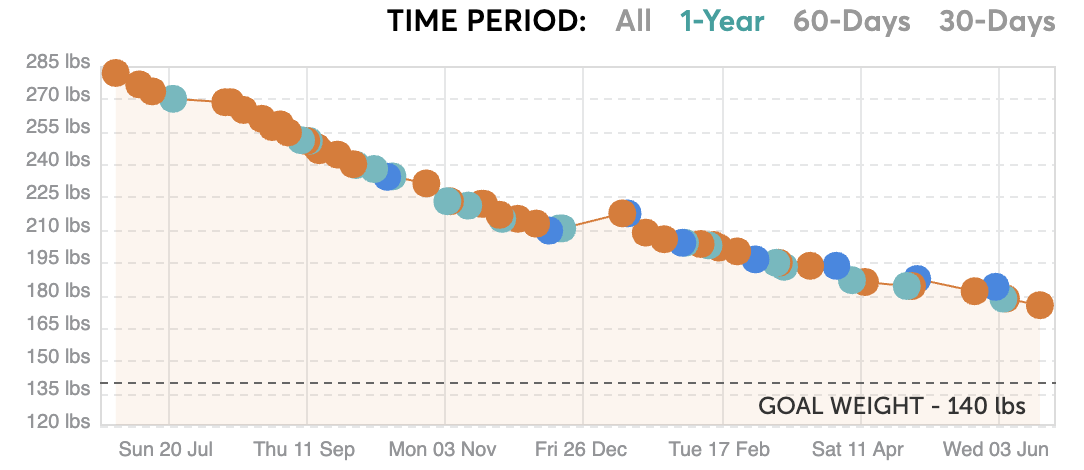
Happy first anniversary to all my Mes: past, present, and future.
Same time next year?
- upper arm (L), forearm (L), wrist (L), ring finger (L), bust, upper waist, lower waist/stomach, hips, upper thigh (L), calf (L), ankle (L) ↩︎

